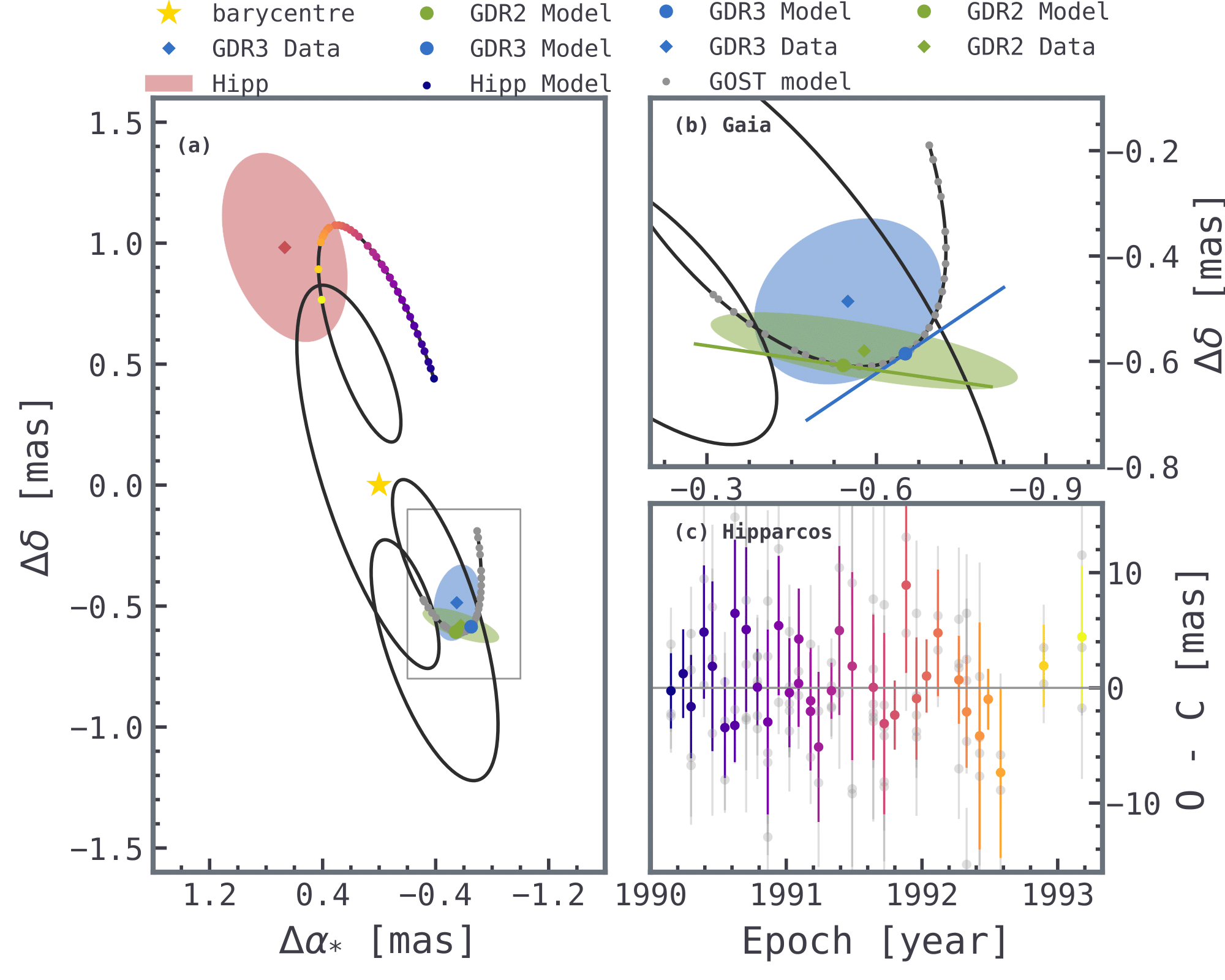
Astrometry
This section is a hands-on tutorial on how to make a simple run with joint RVs with astrometry (RV+AM). We use the HIP 21850 data available on GitHub.
Data
We need to set up our working directory with two subfolders, datafiles and datalogs.
datafiles will contain both our RV and AM catalogues. For each target or system we create a subfolder with the system name. In this case, HIP21850. Inside, we create two subfolders, one named RV, which will contain the RV data, and another named AM, containing the astrometry data.
We copy-paste the file downloaded from GitHub into /datafiles/HIP21850.
📂working_directory
 ┣ 📜mini_test.py
 ┣ 📂datafiles
 ┃ ┣ 📂HIP21850
 ┃ ┃ ┗ 📂RV
 ┃ ┃ ┃ ┗ 📜HIP21850_1_AAT.vels
 ┃ ┃ ┃ ┣ 📜HIP21850_2_HARPS1.vels
 ┃ ┃ ┃ ┣ 📜HIP21850_3_HARPS2.vels
 ┃ ┃ ┃ ┗ 📜HIP21850_4_HARPS3.vels
 ┣ 📂datalogs
 ┃ ┣ 📂HIP21850
 ┃ ┃ ┗ 📂run_1
Setting up EMPEROR
Under our working directory, we create a python file named hip21850_test.
First, we import the library and start our simulation:
import astroemperor as emp
import numpy as np
import multiprocessing
np.random.seed(1234)


sim = emp.Simulation()
sim.cores__ = multiprocessing.cpu_count()
Setting the engine
For this example, we will use reddemcee, with 11 temperatures, 256 walkers, 3000 sweeps each of 1 step:
ntemps, nwalkers, nsweeps, nsteps = 11, 256, 3000, 1

sim.set_engine('reddemcee')
sim.engine_config['setup'] = [ntemps, nwalkers, nsweeps, nsteps]

# Custom adaptation options for reddemcee engine
sim.engine_config['tsw_history'] = True
sim.engine_config['smd_history'] = True
sim.engine_config['adapt_tau'] = 100
sim.engine_config['adapt_nu'] = 1.0
sim.engine_config['adapt_mode'] = 0

# Manual ladder
sim.engine_config['betas'] = list(np.geomspace(1, 0.001, ntemps))
# sim.engine_config['betas'][-1] = 0  # Optionally, for exact evidence estimation

sim.run_config['burnin'] = 0.5  # its in niter
Setting the model
We feed the name of the instruments (optional), as well as the starmass and starmass error to calculate the true-mass and semi-major axis. We add some boundaries to speed up the process:
sim.starmass =  0.9800  # ±0.1150  # hip21850, feng 2022 https://exoplanetarchive.ipac.caltech.edu/overview/HD%2030177
sim.starmass_err = 0.1150
sim.instrument_names_RV = ['AAT', 'HAR1',
                           'HAR2', 'HAR3']

# Model options
sim.jitter_prargs = [0, 10]
sim.eccentricity_prargs = [0, 0.3]
sim.acceleration = 1  # linear trend


# Offsets and Jitters manual boundaries
for i in range(1, 5):
    sim.add_condition([f'Offset {i}', 'limits', [-100, 100]])
    sim.add_condition([f'Jitter {i}', 'limits', [1e-4, 30]])

# we constrain a bit the planetary parameters
sim.add_condition(['Period 1', 'limits', [2000, 3000]])
sim.add_condition(['Amplitude 1', 'limits', [1e-4, 200]])
sim.add_condition(['Eccentricity 1', 'limits', [0, 0.5]])
sim.add_condition(['Phase 1', 'limits', [np.pi, 2*np.pi]])
sim.add_condition(['Longitude 1', 'limits', [0, np.pi]])

# We also constrain astrometric offsets
for offset in ['RA', 'DE', 'PLX', 'pm RA', 'pm DE']:
    sim.add_condition([f'Offset {offset}', 'limits', [-1, 1]])  # usually -10, 10

# Finally, we set some sensible priors for Hipparcos and Gaia
sim.add_condition(['Jitter Gaia', 'limits', [0, 10]])  # fractional jitter
sim.add_condition(['Jitter Gaia', 'prior', 'Normal'])
sim.add_condition(['Jitter Gaia', 'prargs', [1, 0.1]])

sim.add_condition(['Jitter Hipparcos', 'limits', [0, 10]])  # additive jitter
sim.add_condition(['Jitter Hipparcos', 'prior', 'Normal'])
sim.add_condition(['Jitter Hipparcos', 'prargs', [0, 5]])
Plotting Options
We add some plotting options to speed up this test a little. We will only plot the posteriors for the cold chain. Also, we won't use the arviz optional plots.
sim.plot_posteriors['temps'] = [0]
sim.plot_gaussian_mixtures['plot'] = False
sim.plot_trace['plot'] = False
sim.plot_histograms['plot'] = False
Finally, we read the data and run our simulation (it will take a few minutes):
sim.load_data('HIP21850')  # folder read from /datafiles/
sim.autorun(1, 1)
And we see the results:
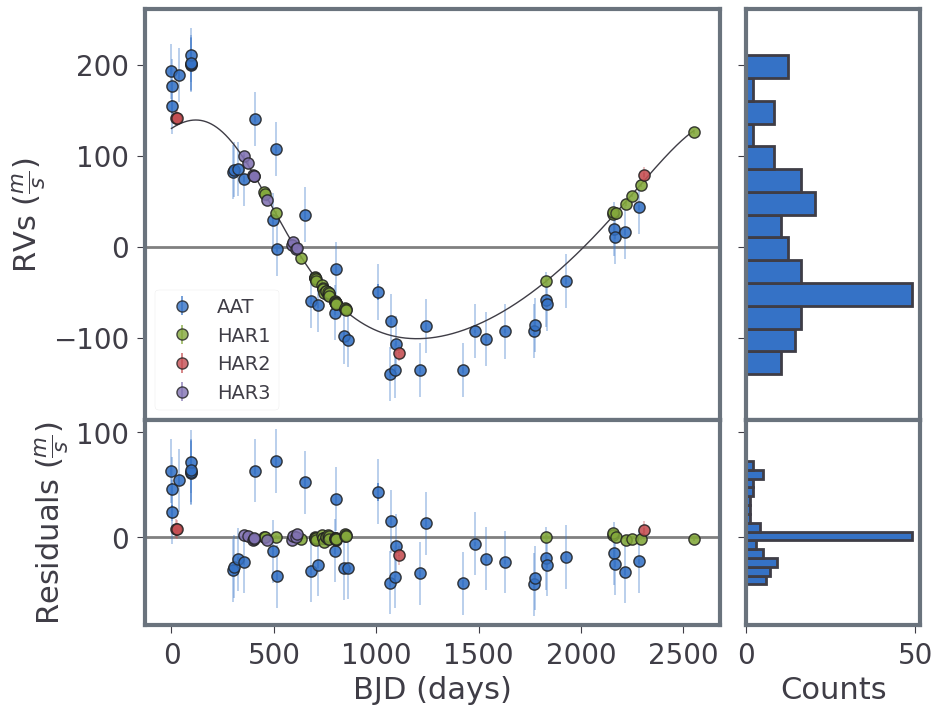
Second signal
Can you find the second planet? Try setting sim.acceleration=0, and period 2 between 5000 and 15000 days!
Hint: